dailyanimal
Custom Search

Wednesday, February 23, 2011

A pair of giant pandas is seen at the Ueno zoo in Tokyo


A female giant panda named Xiannu is seen at the Ueno zoo in Tokyo February 22, 2011. Panda fever showed few signs of dying down in Japan on Tuesday after the arrival in Tokyo of the country's latest pair of giant pandas from China. To match Reuters Life! JAPAN-PANDAS.


A pair of giant pandas arrive at the Narita International Airport from China in Narita city, suburban Tokyo on February 21, 2011 to display at Tokyo's Ueno Zoo. The Tokyo metropolitan government, which runs Ueno Zoo, will pay a giant price tag of 950,000 us dollars (694,950 euros) per year for the next decade to lease the animals. The money is to be spent on wild animal protection in China.


People walk past a panda painting displayed at Ueno Station in Tokyo on February 21, 2011. Panda fever gripped Japan as a pair of the bamboo eaters was heading in from China, with Tokyo's zoo eyeing a visitor boom and the government predicting smoother ties with Beijing.


Male giant panda Bili is seen in Sichuan province in this undated handout photo released to Reuters on February 22, 2011. Bili and female giant panda Xiannu, flew from Shanghai to Narita International Airport and arrived at Ueno zoo in Tokyo on February 21, 2011.


A pair of giant pandas arrive at the Narita International Airport from China in Narita city, suburban Tokyo on February 21, 2011 to display at Tokyo's Ueno Zoo. The Tokyo metropolitan government, which runs Ueno Zoo, will pay a giant price tag of 950,000 us dollars (694,950 euros) per year for the next decade to lease the animals. The money is to be spent on wild animal protection in China.


In this photo released by Ueno Zoological Gardens, known as Ueno Zoo, Ueno Zoo Director Teruyuki Komiya, top, and a Chinese panda keeper check female Xiannu of two giant pandas flown in to Japan from China in a new house after arriving at Tokyo's Ueno Zoo early Tuesday, Feb. 22, 2011. Japan hopes that the two pandas will help warm bilateral ties strained over a territorial spat _ and give Tokyo's economy a jolt, too. EDITORIAL USE ONLY.


A male giant panda named Bili is seen at the Ueno zoo in Tokyo February 22, 2011. Panda fever showed few signs of dying down in Japan on Tuesday after the arrival in Tokyo of the country's latest pair of giant pandas from China. To match Reuters Life! JAPAN-PANDAS.


source: daylife
photo: Gettyimages, Reuters, AP photo

They've got a lot of bottlenose! Dolphins' frolics in front of tanker caught on camera

By DAILY MAIL REPORTER

Double act: The Bottlenoses dolphin play at Chanonry Point, Moray Firth, Scotland


At break-net speed a dolphin bursts from the sea and flies like a bullet straight at the camera.

These pictures form part of one-man's stunning British collection of the world's most northern population of Bottlenose Dolphins.

The dolphins were all caught on camera by devoted amateur wildlife photographer Tim Stenton, 46, from Wirksworth, Derbs.


He has spent an unwavering 100 days stationed on the beach at Chanonry Point overlooking the Scottish Highland's Moray Firth, near Inverness.

Animal lover Tim has faithfully returns to set up camp every year - driven by his passion to catch a glimpse of some of Britain's most spectacular marine mammals.

He said: 'I wanted to celebrate some our most amazing wildlife. My aim has been to capture as much of their behaviour as possible.


Playful: Tim Stenton sets up camp in Scotland every year just to catch a glimpse of the marine animals


'I set up on the beach and just watch out over the waves. With patience you'll eventually spot something.

'And it goes to show you don't necessarily need to be out on a boat. there's plenty of opportunities from land if you are prepared to sit tight.

'There are certain times of the year when the salmon become more concentrated in the area, and this makes spotting the dolphins more likely.


Dance of the dolphin: Photographer Tim captures the animals as they leap in and out of the water


'But the salmon are present all year round, even if there numbers vary, and this means that you can see the dolphins at any time.

'It's nice to see these creatures at home without having to fly to the other side of the world.

'It shows you that there is some amazing British wildlife out there and you can witness some of the most spectacular behaviour in the animal kingdom very close to home.'


Leading the way: This bottlenose dolphin bow rides on the approaching 'Border Thistle', a coastal oil tanker


During his epic one-man project spanning seven years Tim has pictured some dolphins flying straight at the camera.

Other images show the creatures spiralling through the air in unison - and frozen in time by Tim's camera.

A rare photographs shows how Tim spotted three dolphins breaching at the same time in an explosive action-packed moment.


Flipper: The dolphins were all caught on camera during an epic one-man project spanning seven years


He has also captured the dolphins hunting 15-pound Atlantic Salmon - with the huge fish leaping high out of the water in an effort to escape the hunters.

One picture even shows a tiny calf swimming alongside an adult, while opportunities for more perfect shots also come for Tim when he sees them hitching a free ride.

By bow-riding on ships transporting oil to nearby Inverness, the animals save energy for hunting as they ride the wake created by the ships.

Some of the dolphins weigh more than half a ton and can grow to 3.9 metres.

source: dailymail

Tuesday, February 22, 2011

It's thunder thighs: Newest member of the dinosaurs is discovered in Utah

By DAILY MAIL REPORTER

Beast: The Brontomerus Mcintoshi is the newest member of the dinosaurs and was identified after bones, including a shoulder blade and pelvis, were discovered in Utah


Stalking and terrorising its pray, this computer generated image shows the newest member of the dinosaurs.

Named the Brontomerus Mcintoshi, the creature has been given the nickname 'thunder thighs' because of its huge legs and the translation of its name.

Remains of the creature were discovered recently in the American state of Utah by a team of British and American scientists.

They date from the early Cretaceous period, which began around 145million years ago and ended 65million years ago.

The remains included a juvenile's left ilium bone, which forms part of the pelvis, and also a near complete left scapula, or shoulder blade, of a larger, presumably adult, animal.

The scientists also found well preserved vertebrae from the creature as well as a complete rib bone.

They then used the bones they discovered to match certain known criteria to determine what species of dinosaur they came from.

Using five variables, and particularly focused on the size and other factors within the ilium bone, they confirmed it was from the Sauropod family.

It was the eighth discovery of remains from a member of that species in North America and there are expected to be more in the future.

Scientists believe they will find more because the number of dinosaurs within the land mass did not decline significantly at the end of the Jurassic period.

The findings were published in the journal Acta Palaeontologica Polonica.


source: dailymail

Is this the loudest cat in the world? Meet Smokey whose purr is as noisy as a Boeing 737

By ANDREW LEVY

Deafening: Smokey the cat's purrs average an astonishing 80 decibels - more than THREE times louder than most cats


For cat lovers, there is nothing more soothing than the sound of their pet purring with contentment.

But when Smokey kicks off, it’s time to reach for the ear plugs.

The sound she produces can reach an incredible 92 decibels – the same a
s you’d experience watching a Boeing 737 coming in to land.

Even from five feet away the level is 80 decibels, the same as a car passing 25ft away. Most cats produce around 25 decibels.

Owners Ruth and Mark Adams say the 12-year-old British Shorthair can drown out TV and radio shows and phone conversations with her ‘cooing purr’ which they describe as ‘sounding as if she has a dove stuck in her throat’.

Mrs Adams, from Pitsford, Northampton, said: ‘She even manages to purr while she eats. The only time she is quiet is when she is asleep.

'It’s either adorable or annoying, depending on what mood you’re in. You don’t even have to stroke her to start a purring session. Often she’ll do it for no reason.’

Guinness World Records said it had a category in place for noisiest cat but no entries yet. A spokesman said: ‘If Smokey can purr at over 80dB it would be an astonishing feat.’


Record breaker: Owner Ruth Adams has submitted an application for Smokey's piercing purrs to the Guinness World Records


Diana Johnson, of Northampton Cats Protection, who has met Smokey, said: 'I have never heard anything like her purr in my life. It can drown out your conversation.

'It is very unusual and I've never found a cat with a purr that is anywhere near as loud.'

Smokey has become an honorary volunteer for Cat Protection's Northampton branch and is helping to raise awareness of the important cat welfare work they do.


source: dailymail

On reflection, I think I do look rather human...

By DAILY MAIL REPORTER

Mmm... maybe: Orangutan Suman, pictured at Melbourne Zoo, looks contemplative in the 97% Human exhibit


Amazing facial expressions in portraits for 97% Human, project that proves how closely we're related


An orang-utan appears trapped in thought by his own reflection in this amazing portrait captured at Melbourne Zoo.

Using techniques normally employed by baby photographers to produce emotional pictures, talented Arthur Xanthopoulos, 38, has forged an incredible relationship with our primate brothers.

And his striking shots of facial expressions not so dissimilar from theose of humans add tangible evidence to the fact that monkeys share so many of our genes.

The pictures were taken as part of a project called 97% Human, and give us incredibly moving images of orang-utans, gorillas and baboons.

'These primates have the ability to recognise I have a camera and I'm taking photos of them,' explained Mr Xanthopoulous.

'They change their behaviour in response to my presence just like a human model would do.

'There's a personal interaction between myself and the apes which I convey through the pictures.

'I hope to let their unique personalities shine through so people can feel this for themselves, particularly through eye contact- which is a powerful way of communicating for both humans and apes.'


Get lost, this is private? A western lowland gorilla seems perturbed by photographer Arthur Xanthopoulos


In one heart warming image, female orangutan, Suma, 32, gazes at the ripples of her own reflection in the pool of her enclosure.

Another picture shows a western lowland gorilla at Melbourne Zoo in Australia playfully sticking his tongue out at the camera while a very human sadness is evident in the eyes of baboons and apes in the exhibition.

'When people look at the images I've created I hope they will see their own reflection and this will make them think how much more we have in common with primates than the difference in our bodies might suggest,' said Mr Xanthopoulous.

'I see my work as a way to create a degree of awareness in people's minds and help them to see these animals in a different way.'


I want to be alone: A baboon at Melbourne Zoo seems to have recently heard some distressing news


Living close to Melbourne Zoo and striking up friendships with staff gave Arthur prime access to the unusually open primate enclosures he found there.

He prefers to shoot on days where the sky is overcast and the light is even enough to allow him to bring out the features of the primates.

'I try to pick moments when I'm going to see the best of the animal I'm photographing,' he explained.

'I focus on the human characteristics of how primates look and how they sit in front of the camera.'

Melbourne Zoo is home a total of 320 animals species including six orangutans, eight gorillas and many other primate species.


Life - don't talk to me about life: A tree-hanging ape stares sadly into the middle distance


Since Australia's oldest zoo opened in 1892 it has launched international campaigns to save the endangered orangutans of Borneo and the gorillas threatened in the Democratic Republic of Congo.

'I think the most important aspect to my work is that although the primates are living in a zoo, 97 per cent human shows that they're not just animals,' Mr Xanthopoulous added.

'In the wild the habitats these apes depend on are being destroyed at a very high rate.

'They may not be humans and they may not possess the kinds of rights and benefits humans enjoy.

'But they have the same capacity for emotion and feeling as we do and we should respect them as such.

'Ninety seven percent human is food for thought in this regard.'


Can I help you? Menyaru the Orangutan seems to be questioning the photographer's interest

source: dailymail

Monday, February 21, 2011

I didn't think you'd miss a hair or three! Cheeky crow feathers his nest at horse's expense

By DAILY MAIL REPORTER

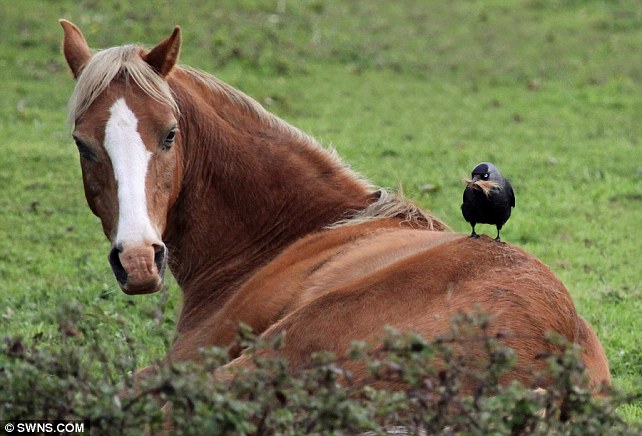
Mind the crow's feet: Retired police photographer David Offord captured this jackdaw pinching hair from a horse's back while on holiday in Buston, near Norwich, Norfolk


When you’ve got a young brood to look after, home improvements have to be done on the hop.

So this determined jackdaw took a plucky approach to feathering its family nest.

The cheeky crow was caught pinching hair from the backs of unsuspecting horses to make a comfortable home for its chicks.

Retired police photographer David Offord captured the bird on camera while on holiday in Buston, near Norwich, Norfolk – then searched for three days until he found its cosy hair-lined nest on top of a chimney on a nearby home.

The 66-year-old, from Stowmarket, Suffolk, said: 'I'm always on the look out. I saw this jackdaw landing on the horses back and thought it was picking insects off it or something.

'But then I saw it was picking up hair. It took me two or three days to work out where it was taking the hair to and then I found the nest on the top of a chimney.

'The horse didn't seem too bothered at all so it must not hurt it too much.'


source: dailymail

Laying this one must have been eggscruciating! The hen's egg eight times heavier than normal

By DAILY MAIL REPORTER

Eggstatic: The giant egg laid by Jeremy Paget's hen, Hattie


For a free-range hen who just laid an egg more than eight times heavier than normal, Hattie the hen seems remarkably unruffled.

The egg weighs a hefty 5.7oz, is three and a half inches long and eight inches in circumference.

Hattie’s owner Jeremy Paget, 50, who has been rearing his nine chickens for only six months, said of Thursday’s find:

‘My wife brought it in to me and asked me to close my eyes and said, “I’ve got a present for you”. We were absolutely gobsmacked.’

He now plans to use the egg to make an enormous omelette.

The financial consultant, of Four Marks, Hampshire, said Hattie did not seem particularly concerned afterwards.

It's not the first time recently that a chicken has laid an enormous or strangely shaped egg.

Last summer Harriet the hen laid an egg 4.5 inches long with a 9.1-inch circumference - both measurements half an inch longer than the previous record holder.


Whoa! Did that really just come out of me? Hattie inspects what she's laid


In Newquay last autumn a hotel chef preparing breakfast was left shell-shocked today after discovering a perfectly round egg, a billion-to-one discovery.

Hens' eggs are usually 2.3 inches long and have a circumference of 5.5 inches.
The heaviest hen’s egg on record so far weighed an astonishing 16oz.


source : dailymail

Sunday, February 20, 2011

New Home for Giant Pandas, Xiannu and Bili


A female giant panda named Xiannu is carried inside a cage in Sichuan province February 20, 2011. Xiannu and Bili, a male giant panda, will be flown from Shanghai to Narita International Airport and be delivered to Ueno zoo in Tokyo on February 21, 2011.


In this photo released by China's Xinhua News Agency, the female giant panda "Xiannu" strolls in the China Conservation and Research Center for the Giant Panda in Chengdu, southwest of Beijing, Sunday, Feb. 20, 2011. Two 5-year-old pandas are due to arrive at Tokyo's Ueno Zoo on Monday. They'll be the zoo's first since the 2008 death of its beloved giant panda Ling Ling.


A male giant panda named Bili is carried inside a cage in Sichuan province February 20, 2011. Bili and Xiannu, a female giant panda, will be flown from Shanghai to Narita International Airport and be delivered to Ueno zoo in Tokyo on February 21, 2011.


In this photo released by China's Xinhua News Agency, people carry female giant panda "Xiannu" in Chengdu, southwest of Beijing Sunday, Feb. 20, 2011. The two 5-year-old pandas are due to arrive at Tokyo's Ueno Zoo on Monday. They'll be the zoo's first since the 2008 death of its beloved giant panda Ling Ling.


A male giant panda named Bili eats inside its enclosure in Sichuan province February 19, 2011. Bili and Xiannu, a female giant panda, will be flown from Shanghai to Narita International Airport and be delivered to Ueno zoo in Tokyo on February 21, 2011.


A female giant panda named Xiannu is pictured inside its enclosure in Sichuan province February 19, 2011. Xiannu and Bili, a male giant panda, will be flown from Shanghai to Narita International Airport and be delivered to Ueno zoo in Tokyo on February 21, 2011.


source: daylife
photo: Reuters, AP photo

Rescued from floods: The lucky to be alive badgers weighing less than four spoons of sugar each

By DAILY MAIL REPORTER

Week old: Tiny badgers in the hands of Pauline Kidner. They weigh less than four spoons of sugar each - and will grow to an average of seven kilos


These super sweet baby badgers weigh less than four spoons of sugar each - and are lucky to be alive after being saved from British floods last week by their quick-thinking mother.

The 2oz cubs are just over a week old and are the smallest ever seen by Secret World Widlife Rescue in Highbridge, Somerset, and signal the approaching Spring.

And because the animals aren't normally seen until they first venture out of their sett at three months, they give a rare glimpse of what early life is like for the animals.

They were found abandoned in a barrel when floods battered Wales a week ago.
Staff say their mother detected the oncoming danger - as animals often sense disasters before they strike - and moved them to higher ground to stop them from drowning.

A local foun
d them desperately calling out while stashed inside and, with their mother nowhere to be seen, they alerted Secret World who took them in.

Because of their light weight and the need to measure them carefully the two females and one male were named Lavender, Saffron and Nutmeg after spices used for cooking.

As the badger cubs' umbilical cords had dropped off and their belly buttons had formed, Secret World charity founder, Pauline Kidner, 60, knew the babies must have been at least three days old when they reached her animal rescue centre last Sunday.

'They're the first of the year and its a nice message for everyone that Spring is just around the corner,' said Pauline.


Tiny: Three lucky to be alive baby badgers being weighed on some scales at Secret World Wildlife Rescue in Somerset


Rescue: Tiny badgers were find inside a barrel - and it is thought their mother had moved them up onto higher ground to stop them drowning


'They were very tiny - the smallest cubs we've ever had,'

'I was actually shocked to see they were badger cubs - I thought at first they must have been rabbits, which are smaller.

'The original call was from a couple in Wales who had their own piece of land.
'Some of the setts in the area were flooded and we believe the mother probably moved the cubs into the barrel for their protection.

'They were distressed so the couple moved them closer to a nearby badger sett - hoping that the mother would return. But nothing happened.

'The cubs were becoming really cold and at such a small size they can't retain their body heat alone, so they called us knowing we had the facilities to rear them.'

The baby badgers will be kept in an incubator and fed milk by members of staff for the first five weeks.

They will then be moved to a cubby hole in Pauline's kitchen where they will be provided with a heat lamp, a warm bed of fleeces and even a webcam so anyone in the world can follow their development on line.

Eventually they will out grow their cubby hole and roam in the kitchen until they are ready to be weaned from their milk.

After this the youthful trio will move to a nearby enclosure with other badger cubs to from a new family. All the badgers will be transferred to a grassy field where all human contact will be restricted -to prepare them for life in the wild.

While there they will learn survival skills such as digging and foraging.


Rare: The animals aren't normally seen until they first venture out of their sett at three months


The cubs can now look forward to a healthy upbringing before they are released back into the wild.

'They're just starting to move their ears - it's interesting to see the development as the days go by,' said Pauline.

'It will probably be another week before they can use their back legs to scratch.
'Badgers are one of the slowest maturing animal we have so it's five weeks before their eyes and ears open.

'They wouldn't normally come up above the ground until they're 12 weeks old.
'What we're seeing is obviously something that people wouldn't normally see.'
When fully grown the badgers can expect to weigh an average of seven kilograms.


source: dailymail

Doggone it: Eddie the Jack Russell is saved by truck driver owner after 19 HOURS trapped underground

By OLIVER PICKUP

Happy ending: Eddie the Jack Russell sticks his nose out of the steel pipe, where he was stuck for hours


This is the heart-warming moment when Eddie the Jack Russell was saved, after 19 hours of being trapped underground.

The one-and-a-half year-old had come loose from his lead, scurried underneath a fence and accidentally fell into a nearby irrigation distribution box, before squeezing into a narrow steel pipe under the asphalt.

Owner Glen Farrell, a truck driver, thought that he had lost his best friend when he returned to the yard in Boise, Idaho, but when he heard backing underneath where he was standing, he and his colleagues quickly set about saving the dog.


Dig for victory: Eddie's owner and his friends dig into the asphalt and dirt to save the dog


Half a dozen men sprung into action and used their diggers and heavy duty equipment to left the earth and cut Eddie out - he had scrambled 30ft up the pipe from its entrance, and could not backtrack.

But as Eddie has wiggled his way up the pipe, he was only a matter of feet under the ground and owner Farrell, who had left Eddie tied in the yard before he went on his job the day before, told KTVB.com: 'I could see him down in there, way down in there.'

An anxious dig, though the asphalt, dirt and, after cutting the steel pipe, Eddie excitedly popped his nose out and saw daylight for the first time in 19 hours.


Heave! Farrell's pals lend a hand in saving one-and-a-half year-old Eddie


Daylight! The Jack Russell squeezes hi nose out of the steel pipe as his owner Glen Farrell cuts the metal


Mucky pup: The rescuers look on as Farrell pulls his dog free from the ground


Shortly afterwards the rest of the dog emerged, and he jumped into Farrell's arms.
'He's shaking a little bit,' said the relieved owner, looking at his shivering black-and-white dog caked in mud.

'He just wants to go home now, and have a bath and sit by the fire, probably. You hear these stories, and you think, well, you know... but here we are. We're one of them now.'

Farrell said that Eddie is always getting into scrapes, but this was the first - and hopefully last - time he has managed to do something like this.


Freed: Eddie jumps out of the hole that has been dig to save him - and after 19 hours underground, boy is he happy


Happy dog: Eddie is delighted to be free - and can't wait for a hot bath and to lie by a roaring fire


source: dailymail

Vermin...or awesome bird of prey? The red kite is back in British towns

By JONATHAN PETRE AND VALERIE ELLIOTT

Flying high: Back from the brink of extinction, the red kites are flourishing across Britain


In Victorian times they were treated like vermin and hunted to the brink of extinction.

But red kites are once again flourishing across Britain, thanks to the efforts of conservationists...and local councils who leave household rubbish to pile up.

The birds of prey are natural scavengers, and experts believe the growing amount of food thrown away, combined with less frequent bin collections, is helping the species thrive.

In Reading up to 60 red kites have been spotted from the roof of a multi-storey car park, apparently watching for the roadkill on which they like to feed.

Earlier this month, BBC1’s The One Show featured a flock attracted to the waste left at a roadside cafe in Oxfordshire, and there have also been sightings in Leeds, Gateshead, Manchester, Birmingham, Coventry and Hampstead and Hackney in North and East London.

Despite the efforts of conservationists, the numbers of red kites plunged to just a handful of breeding pairs in the 1960s, confined to rural mid-Wales.

But a concerted reintroduction programme begun 20 years ago means that there are now thought to be 1,800 breeding pairs across the country.

In medieval times, red kites proliferated in Britain.

By snatching discarded food from the streets, they helped keep towns and cities clean – and kites were protected by a Royal decree, with the death penalty for killing one.

William Shakespeare wrote about their habit of stealing laundry to adorn their nests, and they are known to have carried away dolls, teddy bears and toy cars.

However, by the 16th Century, kites were considered vermin, with a bounty placed on their heads.

By the 1890s, they had been virtually wiped out by landowners who wrongly believed they killed their lambs.

But in the early 1990s, the RSPB released a batch of red kites into the wild in the Chilterns, the first of several such reintroductions across Britain.


Soaring again: A red kite spotted over houses near Slough in Berkshire. Up to 60 have been seen in Reading


One of the sites used was the Buckinghamshire estate of the late American-born multi-millionaire Sir Paul Getty, who hired security guards to protect nests from egg collectors.

Wildlife experts said red kites are drawn to cities because they do not like live prey.

Grahame Madge from the Royal Society for the Protection of Birds said: ‘The red kite is a scavenger, not a hunter, and the birds will gather to feed on carrion, mainly dead rabbits, mice and pheasant, and animals killed on the road.

‘They are not the fearsome predators that people in the Victorian era thought them to be and they are not like a sparrowhawk or kestrel, which would go for a live prey.

‘There have been complaints about red kites attacking dogs and cats but I think these would be very occasional instances.’


Experts believe the growing amount of food thrown away, combined with less frequent bin collections, is helping the red kite species thrive


John Bryant, an urban wildlife expert, said that the amount of food thrown away by families was fuelling the wildlife invasion.

‘The problem is that we’ve got all these bin bags that are raided at night by foxes, rats and squirrels, then the contents are strewn on streets and in gardens,’ he said.

‘Red kites are scavengers and it is not surprising they are also now being spotted in towns.

‘If wheelie bins are too full because the rubbish is not collected as frequently as it once was, people will leave black bags on top or put them inside but not close the lid, so the wildlife can still get at them.

‘In some areas, people are expected to leave black bin bags in the street to be collected. That is an invitation to scavengers.’


source: dailymail

Giant pandas named Bili and Xiannu


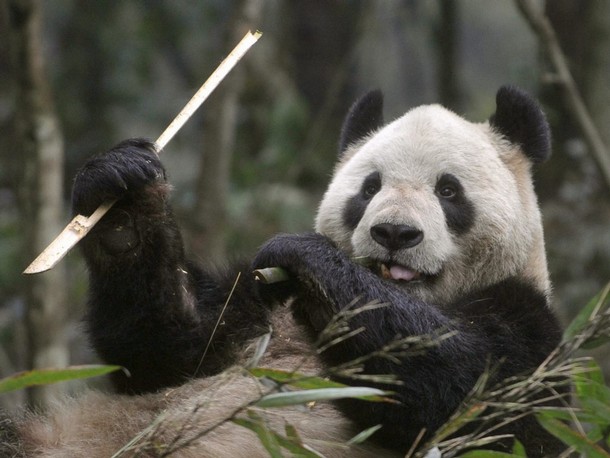
A male giant panda named Bili eats inside its enclosure in Sichuan province February 19, 2011. Bili and Xiannu, a female giant panda, will be flown from Shanghai to Narita International Airport and be delivered to Ueno zoo in Tokyo on February 21, 2011.


A female giant panda named Xiannu is pictured inside its enclosure in Sichuan province February 19, 2011. Xiannu and Bili, a male giant panda, will be flown from Shanghai to Narita International Airport and be delivered to Ueno zoo in Tokyo on February 21, 2011.


source: daylife
photo: Reuters

Monster meets its match: Record-breaking alligator gar fish caught in Mississippi lake

By Daily Mail Reporter


Biologists with the Mississippi Department of Wildlife, Fisheries, and Parks measure the record-breaking alligator gar


It may not have been love at first sight but it was certainly a Valentine's Day to remember for angler Kenny Williams when he landed an alligator gar that tipped the scales at a world record 327lbs.

Williams, from Vicksburg, Mississippi, bagged the fish in Chotard Lake, Issaquena County, using nets to catch it and then grabbing it by the gills to heave it into the boat.


Biologists with the Mississippi Department of Wildlife, Fisheries, and Parks measured the beast at 8ft 51/4ins long, with a girth of 47.95ins, and estimated it to be between 50 and 70 years old

The current International Game Fish Association record belongs to a 279-pounder pulled from the Rio Grande in Texas in 1951.

'At first I didn't think he was that big. But as I was getting him into the boat, it was like, How big is this thing? It was a lot of effort just to get him into the boat,' Williams told ABC affiliate WAPT-TV in Jackson.


Chotard Lake where the gigantic alligator gar lurked for between 50 and 70 years


Williams donated his catch to the Mississippi Museum of Natural Science in Jackson, where it will be mounted and placed on display.

Alligator gars are the biggest species of gar. It is not uncommon for an average alligator gar to reach a length off 7-8ft and a weight around 100-120lbs, making it one of the biggest species of freshwater fish in North America.

It has several notable characteristics, the most notable being a dual row of teeth in the upper jaw. The teeth are small, but they are razor-sharp and can easily shred prey.


Source:Dailymail

Saturday, February 19, 2011

Mewdini: The feline escape artist who just loves nothing more than a tight squeeze

By MAIL FOREIGN SERVICE


In a pickle: Ksyusha the kitten loves nothing more than a tight squeeze


You've heard of the cat in the hat. Now meet the cat in the vat.

It certainly seems that Ksyusha the kitten has got herself into an impossibly tight spot.

But according to her owner she has no problem escaping the glass container, rather like a feline Houdini.


Playful: The excitable female kitten has been squashing itself into jars from when it was a few weeks old


Cute: The cat's owner has been taking photos of her animal and posting them on the internet since the start of last year


‘It looks like she is stuck, but actually her body is not as big as it looks because of the large amount of fur,’ said Yuriy Korotun, who lives in Moscow.

‘She likes hiding in different places and is full of character.’


In a spin: The female kitten has been always been playful, according to her owner


Mischievous: Ksyusha plays with a chair leg


Yuriy said he first realised his pet, a Himalayan breed similar to a Persian, had a love of confined spaces when he heard a commotion in her kitchen one day.

‘I came in to find her in the jar,’ he said. ‘I couldn’t believe my eyes.’

She is also partial to curling up in the washing machine, said Yuriy, who has posted pictures of Ksyusha on the internet.


Similar: Ksyusha's ability to get in and out of seemingly impossible situations harks back to the comedy capers seen in classic kids' cartoon Tom & Jerry


Korotun got the shock of his life one day when he heard some commotion in his kitchen and discovered the fun-loving feline with more than her paws in the jar.

Her ability to get in and out of seemingly impossible situations harks back to the comedy capers seen in classic kids' cartoon Tom and Jerry.

source: dailymail

Twitter Delicious Facebook Digg Stumbleupon Favorites More

 
Powered by Blogger