dailyanimal
Custom Search
Showing posts with label Bees. Show all posts

Monday, July 18, 2011

The bee’s knees? Chinese contestants cover themselves in insects for ‘bee bearding’ competition

By BY DAILY MAIL REPORTER

Daredevil: Beekeeper Wang Dalin, 42, stands with bees covering his body on a weighing scale during a 'bee-bearding' competition.


Chinese farmer Wang Dalin will certainly 'bee' happy after winning this incredible competition.

The 42-year-old beekeeper was competing in a daring 'bee bearding' contest in Shaoyang, Hunan Province of China, against 20-year-old farmer Lv Kongjiang.

The pair competed by standing on a scale wearing only a pair of shorts.

They then used queen bees to attract other bees onto their bodies.

Fearless: Wang Dalin shortly before the bees completely covered his body


Mr Dalin was crowned the winner after attracting 26.86kg of bees onto his body in 60 minutes, according to local newspaper reports.

Mr Kongjiang managed to attract a slightly lower 22.9 kg.


Second place: Lv Kongjiang waves at onlookers watching the 'bee bearding' contest


The event attracted a large crowd of fascinated onlookers.

However, unlike the competitors, many of them took the more sensible option of wearing protective clothing.
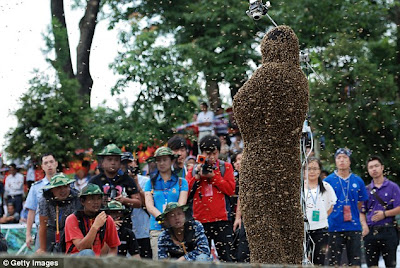

Support: Crowds watch as bees cover Wang Dalin


source: dailymail

Saturday, July 9, 2011

S'warm in 'ere! Staff trapped in chocolate shop for almost THREE HOURS after thousands of angry bees threaten to invade store

By DAILY MAIL REPORTER

Help! Terrified staff at Thorntons were trapped for nearly three hours after they were attacked by this swarm of bees


This is the incredible moment terrified staff at Thorntons chocolate shop were trapped for nearly three hours after they were literally bee-sieged - by a buzzing swarm.

The sweet store was forced to close for two-and-a-half hours after thousands of bees swarmed around the queen in its doorway.

Staff at the shop in Leominster, Herefordshire, said it was like something from a horror film as they watched an angry cloud of black and yellow coming at them.


Buzz off: The bees are believed to have swarmed the shop to protect a queen bee which had been ousted from a nearby nest


They were forced to hide inside the shop, barricading the door with chocolate boxes, while a beekeeper was called.

Shop assistant Kim Kinsey said: 'I thought they had been attracted to the shop by the sweet smell of the chocolate, but the beekeeper explained they follow the queen.'

The bees are believed to have swarmed the shop to protect a queen bee which had been ousted from a nearby nest by a younger female.

They were eventually removed by a beekeeper after tourist information centre manager Gill Ding raised the alarm.

Ms Ding, 45, said: 'Nobody seems to know where they came from but it was probably from a large hive. It was quite alarming.


source: dailymail

Friday, January 21, 2011

New pesticides are 'killing honeybee population worldwide'

By DAVID DERBYSHIRE

Dying? Honeybees are being wiped out by new pesticides that have left them far more vulnerable to disease, the top U.S. bee expert has warned


A new generation of pesticides could be to blame for Britain's vanishing honeybees, a study has shown.

The chemicals, which are routinely used on farms and garden centres, attack the central systems of insects and make bee colonies more vulnerable to disease and pests, researchers say.

The claims, which appear in an unpublished study carried out at the US Department of Agriculture's Bee Research Laboratory, add to the evidence that pesticides are partly responsible for the mysterious decline of one of the world's best loved insects.

Wildlife campaigners today called for urgent research into the links between the chemicals and the collapse of bee colonies around the world.

Scientists are baffled by Britain's disappearing honeybees. Since the 1980s numbers have fallen by half.

The new study, led by Dr Jeffrey Pettis, one of the U.S.'s top bee experts, found that exposure to a class of pesticides called neo-nicotinoids makes bees more susceptible to infection - even at doses too low to be detected in the creature's bodies.

Neo-nicotinoids, which were introduced in the 1990s, are applied to seeds and are found in low levels throughout a growing plant - including in its pollen and nectar.

They were introduced to replace controversial organo phosphates because they appeared to be harmless to mammals and people and are used on oil seed rape, wheat, sugar bed and garden centre plants.

The U.S. research has yet to be published, but is discussed in a new documentary film The Strange Disappearance of The Bees.


Neo-nicotine insecticides attack the central nervous system and are absorbed by every part of plants that are treated with them. Bees and other pollinating insects can absorb them and carry them back to their hives or nests


Insect charity Buglife today said previous studies in France had found a link between pesticides and vanishing bees.

Director Matt Shardlow said: 'This American study shows that even at levels where you can no longer detect the substance in bees, it is still having an impact on their health.

'People have been wondering what is the cause of the decline of bees and moths and bumblebees in Britain. And the research is further evidence that pesticides are a potential cause.'

The Co-op is so concerned about neo-nicotinoids it has banned them on its UK farms.
Bayer - the German chemical giant that makes many of the neo-nicotinoids used in Europe - insisted its products did not harm bees.

A spokesman said it was difficult to comment on unpublished studies and that it was impossible to look at the methods used by the researchers.

'I'm sure there are some very interesting effects Dr Pettis has seen in a laboratory, but in reality, when you get to what's important to everybody which is what happens in the field, you don't see these things happening,' he said.

'Bees are very ,very important insects to BayerCropScience and we recognise their importance.'

Honey bees are essential for British farmers and are thought to contribute around £200million to the economy by pollinating crops on farms, allotments and in gardens.


source : dailymail

Thursday, December 23, 2010

Scientists launch fightback against mite that is wiping out our bees... by making it self-destruct

By DAVID DERBYSHIRE

A honeybee with a Varroa mite (circled) attached to it. Conservation groups are welcoming a breakthrough in the battle against the deadly mite responsible for decimating the honeybee population


For 20 years it has ruthlessly attacked Britain's hives - wiping out millions of bees and bringing misery to honey producers.

But now scientists have launched the fightback against the invasive, blood sucking varroa mite parasite - the world's biggest killer of bees.

The bug drills a hole in the honey bee's back and drinks its blood while injecting viruses to suppress the bee's immune system leaving it vulnerable to disease.

Attempts tried to wipe it out but they failed as it becomes increasingly resistant to chemicals.

Now researchers have developed a new technique that turns off genes in the pest's DNA, forcing the bugs to self-destruct.

Although the treatment is still experimental, it could eventually kill the mites without harming bees within years.


The breakthrough won't come soon enough for Britain's beleaguered honey bees - in England alone the population has shrunk by 54 per cent since the 1980s as a result of the varroa mite, pesticides, industrial farming and disease.

Farmers say the decline could be disastrous for agriculture because bees are vital for pollinating crops and are worth an estimated £200 million to farming each year.


A varrao mite. The tiny creatures infect bees with viruses suppressing their immune system


The new treatment would allow beekeepers to treat the parasites without harming the bees. Currently they have to use pesticides.

Prof Francis Ratnieks, a bee researcher from the University of Sussex, said it could be a long time before it was used on British bees.

'It may be possible to use gene knockout techniques such as RNAi to learn more about the physiology of pests and to use this to develop ways of controlling them, maybe by the development and application of novel pesticides,' he told the BBC.


source: dailymail

Tuesday, December 14, 2010

Why bees that are too tired make mistakes with their 'waggledance'

Worker bees need sleep to be able to perform their waggle dance accurately


Just like tired and stressed humans, busy bees that get too little rest start to make mistakes, scientists have found.

Worker bees have the important job of letting their hive-mates know where to find food.

They pass on the information by performing a 'waggle dance' containing coded directions to nectar-rich flowers.

But when the insects were deprived of sleep their ability to communicate clearly began to suffer.

Their dances became sloppier and less precise than those of rested bees.

Dr Barrett Klein, from the University of Austin, Texas, US, said: 'When deprived of sleep, humans typically experience a diminished ability to perform a variety of tasks, including communicating as clearly or as precisely.

'We found that sleep-deprived honey bees also experienced communication problems. They advertised the direction to a food site less precisely to their fellow bees.'
The research involved disturbing sleeping bees with a magnetic device aptly named the 'insominator' by the scientists.

As the magnet was waved over bees fitted with small metallic backpacks it caused them to be jostled around and woken up.

After a sleepless night, the behaviour of the bleary-eyed insects' was compared with that of rested bees.

Fatigue was found to have a noticeable effect on the quality of their waggle dances.
'The dance was not necessarily wrong, but it was less precise than dances performed by bees that were not sleep-deprived,' said Dr Klein.

'We expect that a less precise dance would lead to fewer followers making it to the food source, and we hope to test this in the future.'

The research is reported in the journal Proceedings of the National Academy of Sciences.

source: dailymail

Sunday, November 21, 2010

We're the bees' knees! Staff at China bee farm are covered in thousands of insects as part of show

By DAILY MAIL REPORTER

Making a bee-line: Yang Chuanquan, chairman of the Nanning Quanjian Bee Farm, waves to the crowd as the swarm of bees buzzes around him


This looks like it could have more than one sting in the tail as two staff at a China bee farm put on a show.

Yang Chuanquan, the chairman of the board at Nanning Quanjian Bee Farm, is pictured with a colleague covered head to toe in honey bees.

The smiling pair seem unperturbed by their buzzing buddies as they performed in Nanning, capital of southwest China's Guangxi Zhuang Autonomous Region.

Tens of thousands of the bees were poured on to the pair by other staff apart from a small opening over their faces.

It is unclear whether bits of honeycomb or nectar was used to entice the little insects to remain on the two workers, but they are not believed to have been stung.


Creating a buzz: The two members of staff smile for the camera as the industrious insects cover their entire bodies


Attraction: The bees were 'poured' on to the two people by other staff, but is is unclear if they had honeycomb or nectar to entice the insects to stay


source: dailymail

Twitter Delicious Facebook Digg Stumbleupon Favorites More

 
Powered by Blogger